
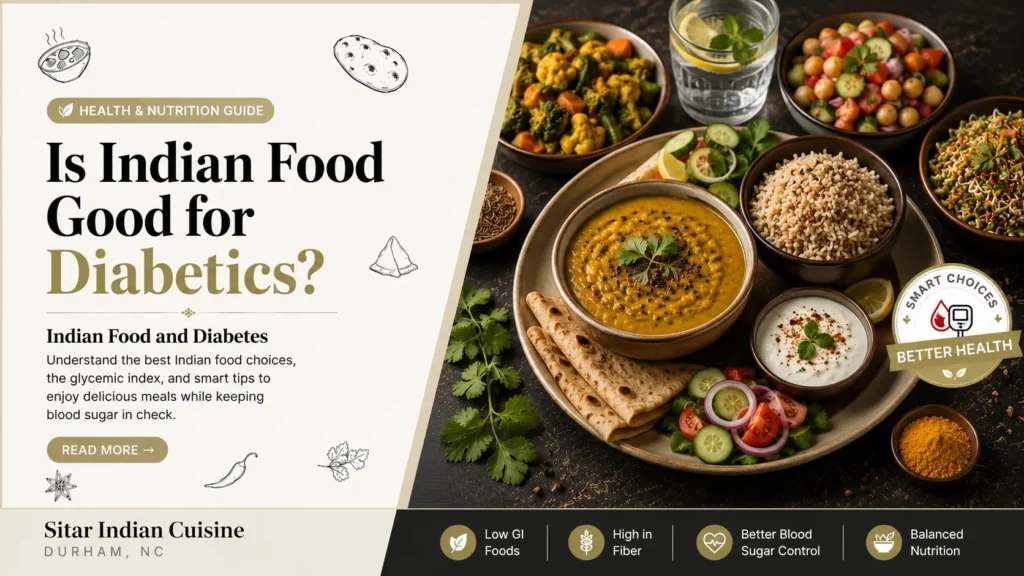
Can I still eat Indian food if I have diabetes? This is likely one of the top questions every person diagnosed with or trying to control blood sugar has upon hearing they have diabetes. It’s good news for any lovers of curry and other dishes, you know Indian food and diabetes don’t have to be enemies. The goal here is to learn what foods promote slow and steady blood sugar release, versus which foods are to be enjoyed with mindful moderation. And for anyone searching for authentic cuisine at an Indian food restaurant Durham may host, eating these favorites is certainly within reach.
At Indian restaurants like Sitar Indian Cuisine, you’ll have ample traditional dishes available and you can select healthy ones in addition to what you might feel guilty about eating at other times. Whatever your South Indian Buffet preference is versus ordering individually, having an understanding of what each ingredient influences your blood sugar will help you order well. This post, told simply, covers all it takes from the glycemic index of Indian food to deciding between the healthiest Indian dishes or creating a well-rounded weekly food plan.
Disclaimer: This article reflects culinary insights from 22+ years of preparing traditional Indian cuisine. It is intended for educational purposes only and does not substitute for professional medical or nutritional advice. Always consult a healthcare provider or registered dietitian regarding personal dietary management.
Is Indian Food Good for Diabetics? The Real Answer
Well yes, it certainly is possible, but it depends what you eat. Indian food is amazingly complex. The way food is prepared, the grains, the vegetables, the spices are all different from one region of India to the other. Because of that there is never just one answer for Indian food and diabetes.
In fact, lots of traditional home style Indian food should actually help you manage blood sugar. These dishes use :
- Lentils (like dal,moong and chana)
- Fresh, seasonal vegetables
- Whole grains
- Fermented milk products (like curd)
- Herbs (turmeric, ginger, cumin, coriander, fenugreek etc.)
With the above ingredients, we have fiber, protein, minerals and Vitamins which will help to reduce carbohydrate levels to the maximum, and in order slow down the blood levels from taking effect immediately into our system after our meal.
However not all Indian food is a miracle. Any Indian dish high in maida, deep fried samosas and pakoris, sweet jalebis and ladoos, huge portions of plain white rice, are all going to spike blood sugar. So here are some of the healthier Indian food choices you may want to focus on. For Indian food and Type 2 Diabetes, a more appropriate question to ask your health care provider would be: Which Indian food is good for me?
You’d find the traditional roti (whole wheat), vegetables, dal and even the curd, all served together with an infusion of nutrients to keep the body in sync. These were the foods we would gorge on before the convenience of processed foods arrived.
How Indian Food Affects Blood Sugar by Understanding the Glycemic Index
One of the simplest ways to evaluate any cuisine in terms of managing diabetes is to consider foods’s respective glycemic index, or simply, what each food contributes to changing the sugar content of blood cells throughout the day.
High foods-those with a high glycemic index-will spike the level of blood sugar in people with diabetes more acutely than low glycemic index dishes. Conversely, the opposite is to be said about the latter, a steady-burning fuel which, in the long term, assists blood sugar stabilization in diabetic patients, among them people of Indian origin that could benefit greatly from a less carbohydrate focused diet while consuming healthy Indian food.
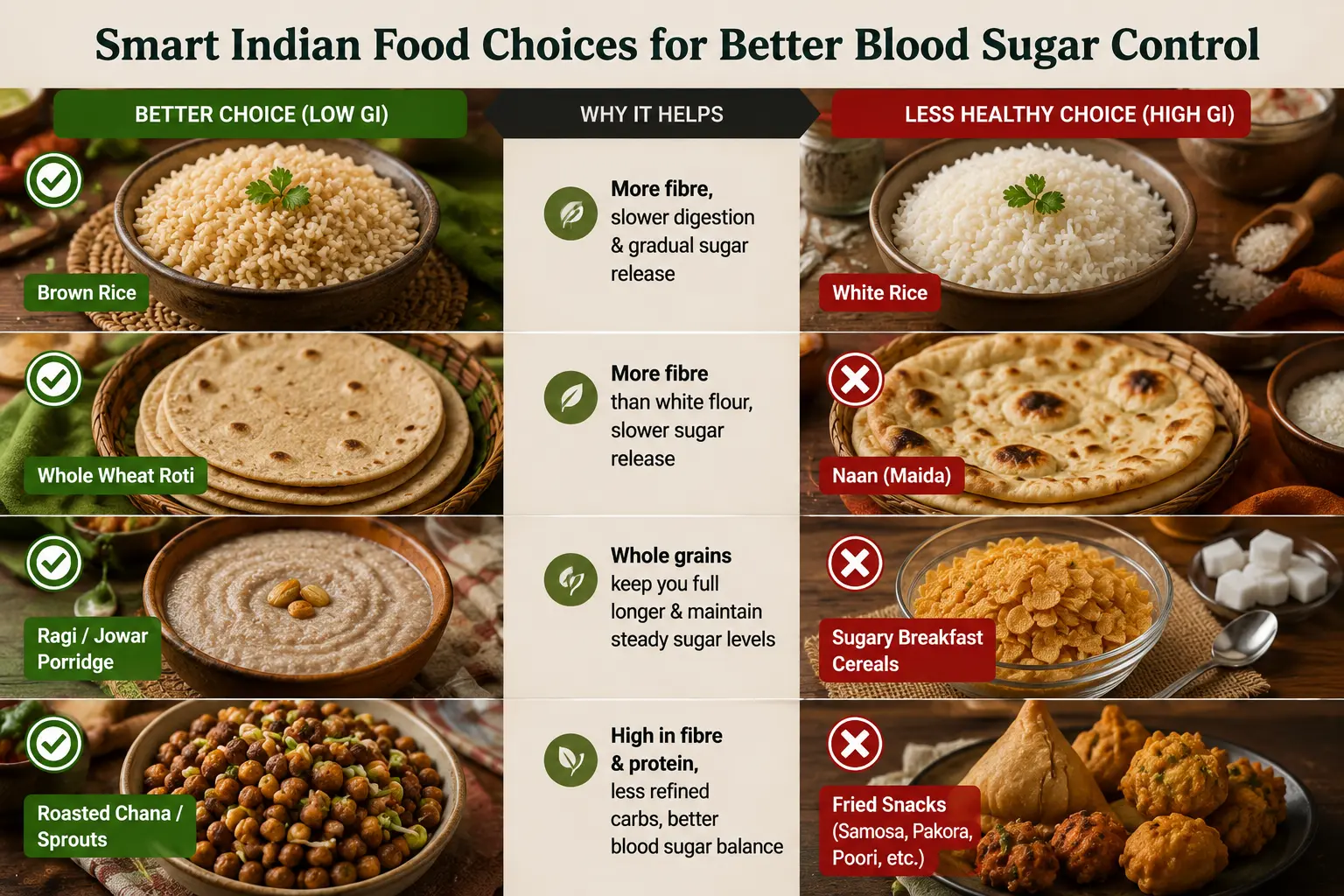
Here are a few simple comparisons:
| Meal | Better Choice | Why It Helps |
| White rice | Brown rice | Brown rice has more fibre hence digestion slows down and blood sugar gets released slower |
| Naan made with maida | Whole wheat roti | Whole wheat has more fibre than white flour breads, tends to be slow sugar release |
| Sugary breakfast cereals | Ragi or jowar porridge | The slow release from whole grains helps keep you full and steady sugar levels. |
| Fried snacks | Roasted chana or sprouts | High in fibre, protein. Lesser refined flour for better balance. |
Science indicates that compared with brown, white rice brings blood sugar up at a relatively faster pace. The reason is the white flour is stripped of the healthy fiber filled outer casing. Similarly, as the foods listed above, the naan, and other dishes prepared with the white flour cause a relatively faster ascent of the blood sugar than the dishes using the wholewheat flour. Lastly, beans, dal, moong, kidney beans, chick peas and legumes fall into this group.
These are chock full of protein and fiber which slow down sugar absorption into the bloodstream.
Of course, quantity plays a role even with some foods. Eating massive quantities of what looks otherwise healthy, such as rice, could still put your blood sugar to the test, a balanced meal with heaps of veggies and portioned grain, lean protein and legume may just be a better option. Knowing this would make controlling Indian food and diabetes much more simpler.
Here are a few common eatables that can help cut down on the number of carbohydrates:
- White rice: White rice are easily digestible and are some of the simplest carbohydrates that result in quickly jumping levels of glucose as they have lesser fiber compared to other grains. Alternatively, pick over a portion of brown rice, ragi, jowar, bajra, or a smaller serving of white rice served with vegetables and lentils.
- Naan and maida based food: Typically the kind of naan and kulcha we usually eat from restaurants and almost half of bakery food products that often use highly refined maida, have a high glycemic index. Rather pick a whole wheat roti,jowar or bajraroti.
- Deep-fried food: Such foods like samosas, pakora, pooris, kachoris are a blend of refined complex carbohydrates and fats which can spike blood glucose levels so, are unsuitable to be consumed daily, suggested a Delhi based nutritionist . Instead you could have the much healthy roasted chana,Grilled paneer, sprouting foods.
- Sugary Indian sweets: These delights asGulab jamun, Jalebi, Rasgulla, laddu, barfi consist entirely of simple sugars and ideally should not be a routine item in any eating plan unless on a very specific and rare occasion . Instead, eat fruits (in small quantities, particularly high carbohydrate sources) or unsweetened Greek yogurt combined with a handful of nuts to curb sugar cravings .
- Sweet lassi and Desserts: Many versions of restaurant lassis, milkshakes, and even several desserts contain a significant amount of sugar which can spike blood glucose extremely fast
Opt for unsweetened lassis,plain buttermilk, or curd with cucumber.We are aiming to limit those, not banish them all together from our life forever, a reasonable moderation will work for most of the Indian eaters.
Indian Foods That Support Healthy Blood Sugar
Many ingredients have already been used in home remedies since ages which helps keep your blood sugar stable. Indian foods that contain high fibre, protein, healthy fats and micro nutrients keep us filled and satiated.
- Whole grains and millets
You can really tell the difference if you swap refined grains for whole grains.
Excellent choices include:
These grains digest more slowly and lead to a more gradual hike in sugar blood level than that of white rice or refined flour products, which don’t.
- Lentils and legumes
Dal, moong, chana, rajma and more are all totally packed with their nutrition values.
They are naturally rich in:
Because they digest more slowly, legumes provide you with sustained energy release and support good blood sugar control.
- Non-starchy vegetables
Each meal should consist largely of vegetables.
Examples include:
Light in calories and abundant in fibre. These vegetables would be an excellent food to have with rice or roti.
- Protein-rich dairy
Protein slows down digestion and extends the feeling of fullness after eating.
Good options include:
These foods are an ideal accompaniment to vegetables and whole grains.
- Beneficial spices
There are already a range of spices used in Indian cooking that can add to a healthy meal.
These include:
Though spices will not cure diabetes, they help to offer flavour without sugar and excess fat, and motivate the use of fresh ingredients.
A healthy Indian vegetarian breakfast for diabetic people
You can find Indian vegetarian breakfast for diabetes which will suit the bill more easily than you can imagine.
Healthy breakfast ideas are Protein, fiber, and carbohydrate combined to bring you breakfast that keeps blood sugars from dipping all morning.
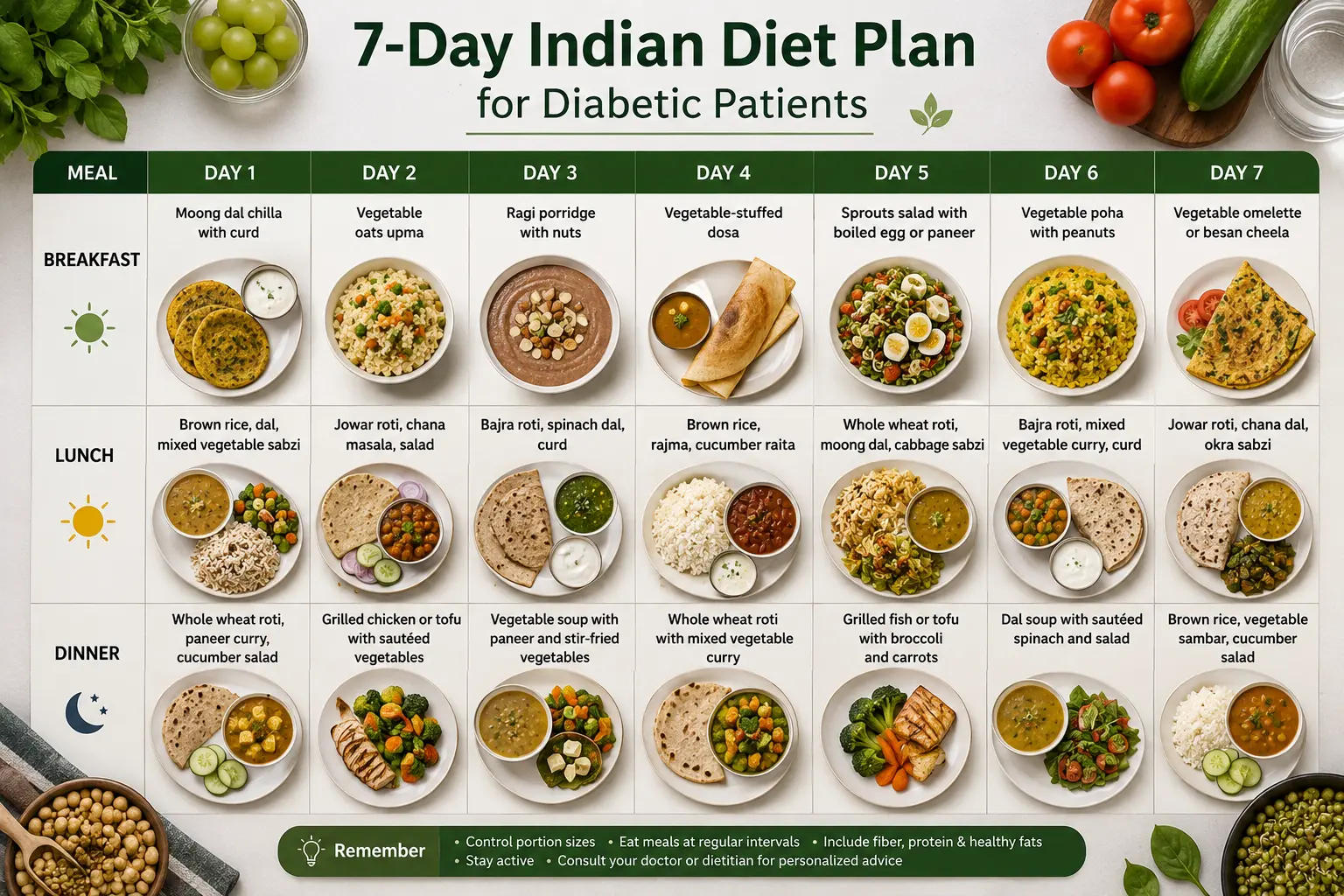
7-Day Indian Diet Plan for Diabetic Patients
Here are some straightforward ideas: How many you should be taking at dinner is specific for you and should be determined by the amount of physical activity that you do per day, so consult your doctor or registered dietitian for guidance.
| Day | Breakfast | Lunch | Dinner |
| Day 1 | Moong dal chilla with curd | Brown rice, dal, mixed vegetable sabzi | Whole wheat roti, paneer curry, cucumber salad |
| Day 2 | Vegetable oats upma | Jowar roti, chana masala, salad | Grilled chicken or tofu with sautéed vegetables |
| Day 3 | Ragi porridge with nuts | Bajra roti, spinach dal, curd | Vegetable soup with paneer and stir-fried vegetables |
| Day 4 | Vegetable-stuffed dosa | Brown rice, rajma, cucumber raita | Whole wheat roti with mixed vegetable curry |
| Day 5 | Sprouts salad with boiled egg or paneer | Whole wheat roti, moong dal, cabbage sabzi | Grilled fish or tofu with broccoli and carrots |
| Day 6 | Vegetable poha with peanuts | Bajra roti, mixed vegetable curry, curd | Dal soup with sautéed spinach and salad |
| Day 7 | Vegetable omelette or besan cheela | Jowar roti, chana dal, okra sabzi | Brown rice, vegetable sambar, cucumber salad |
So as you see from the meal plan, Indian food and diabetes management need not be exotic, costly or complicated. Simple home-style meals composed from entire grains, vegetables, lentils and beans, healthy fats, curd and lean protein would fulfill your dietary needs wonderfully.
Bear in mind that apart from food choices it is also important to regulate your portion sizes and provide a steady intake of nutrients. Having meals on a fixed schedule and in limited amounts in a balanced manner is what truly provides stable blood glucose levels.
Ancient Indian Diet was a Well-balanced Diet
Long before modern food trends, the ancient Indian diet was perfectly balanced. Whole grains, lentils, vegetables and curd/curd like products, and fat in little amounts was a staple food. These inputs provide adequate amounts of fiber, protein, nutrients and help you stay satiated for a good amount of time. Modern diet, on the other hand, does not maintain this equilibrium and rather involves considerable amounts of white rice, maida, sodas and fried food. It is these modern dietary trends rather than the Indian diet, that have made the managing of blood sugar more difficult than they should be for so many people.
At Sitar Indian Cuisine, authentic cooking is not an issue. Try the South Indian Buffet, or a host of other recipes you see on our menu. Learn more about our cooking philosophy on our about page.
The conclusion is really very simple: Diabetes and Indian food are not mutually exclusive; by returning to the principles of balanced, natural eating. Indian food becomes a delicious and smart choice for many managing diabetes.
Final Verdict: Is Indian Food and Diabetes Connected?
Managing diabetes does not have to mean cutting out Indian cuisine and other foods you love. Indian food and diabetes are more about making smarter choices than avoiding anything. By switching from refined grains to whole grains, filling your plate with veggies and lentils, enjoying leaner proteins and portioning yourself correctly you can still get to enjoy authentic Indian cuisine. Indian cuisine and diabetes type 2 does not need to be complicated.
Whatever your reasons for eating healthier and looking for nutritious meal ideas may be, there are many traditional Indian foods that make it perfectly possible and delicious. Small and constant changes often prove to be more effective over the long term than deprivation. Longing to sink your teeth into a delicious Indian meal that helps you keep diabetes under control. Stop in Sitar Indian Cuisine’s South Indian Buffet in Durham for healthful, traditional Indian food that is full of a variety of delicious foods you are sure to love. Don’t hesitate to ask the staff at Sitar Indian Cuisine if you have any questions about any part of the menu they would be happy to answer your concerns.
Frequently Asked Questions
1. What is the #1 worst food for blood sugar?
Most foods with the highest effect on your blood sugar are those containing sugar, like drinks, sweets and refined food made out of flour and added sugars. Sugary drinks, cakes and candy have a very rapid effect on your blood sugar since they are absorbed at speed. It makes more sense for you to avoid certain foods than all kinds of foods that contain carbohydrates.
2. Is curry good for diabetics?
As long as it’s well-cooked the answer is yes. Vegetarian, chicken, lentil and fish curries with a limited quantity of oil are excellent food options for diabetics, due to the plenty of fiber and protein that it offers. Curries with lots of butter cream, sugar and sweet coconut based sauces have to be consumed only in limited portions.
3. Which cuisine is best for diabetics?
All in all a good type of cuisine comes in a healthy proportion of grains, greens, lean protein, legumes and healthy fat in it. TraditionalIndiancuisine comprises a wide variety of delicious and balanced dishes that include the ideal foods for diabetes but need to be made out of fresh products and a limited portion-sizing .
4. What Indian foods should I avoid with diabetes?
When suffering from diabetes , try to consume portions of white rice, naans and alternative kinds of maida based food, fried dishes such as samosas as well as pakoras, sugar rich items such as and sweets like gulab jamun in tiny proportions . You want to favour Indian whole grains like roti made out of wheat, lentils, vegetables,millets and protein-enriched food when possible.